
Reviewed · BOGOTÁ TOURS
Biking in Full Color: Urban Art Bike Tour
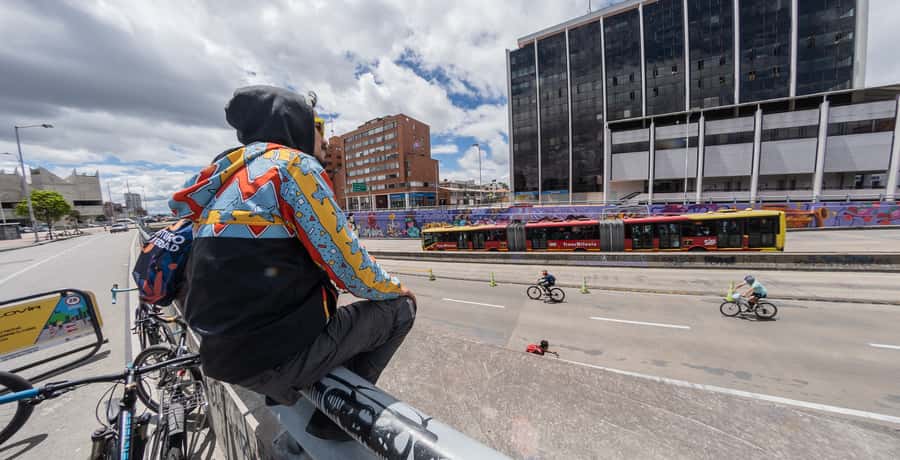
Bogotá’s street art makes the city feel like an open-air classroom, and this 13-kilometer bike ride gives you a practical way to reach murals spread across several central districts. You will pedal through Centro, Teusaquillo, Santa Fe, and La Macarena, stopping to discuss art, politics, architecture, and Colombia’s long road toward peace.
I like the focus on female artists and post-conflict murals, two subjects that give the ride more weight than a simple photo stop. I also like the use of bike lanes, and the chance to join Bogotá’s Sunday Ciclovía when the city opens more streets to cyclists. The main drawback is that the tour runs rain or shine, and three hours of riding may feel demanding if you are not comfortable on a bicycle.
Key points at a glance
- Four central neighborhoods: Ride from La Candelaria through Centro, Teusaquillo, Santa Fe, and La Macarena.
- A guide who works in the art world: Guides are passionate about street art, and Diego has led departures with strong local knowledge and community connections.
- Art with a political edge: Learn how murals address social struggle, identity, peace, and Colombia’s post-conflict period.
- A women-focused art trail: Several walls feature illustrations by female artists, giving the route a useful focus often missed on general city tours.
- A coffee-factory stop: The break adds a local food-and-production angle to the mural route.
- Cycling logistics matter: Wear sports shoes, leave valuables and backpacks behind, and bring clothing suitable for changing weather.
Starting at La Candelaria and reading the city in color
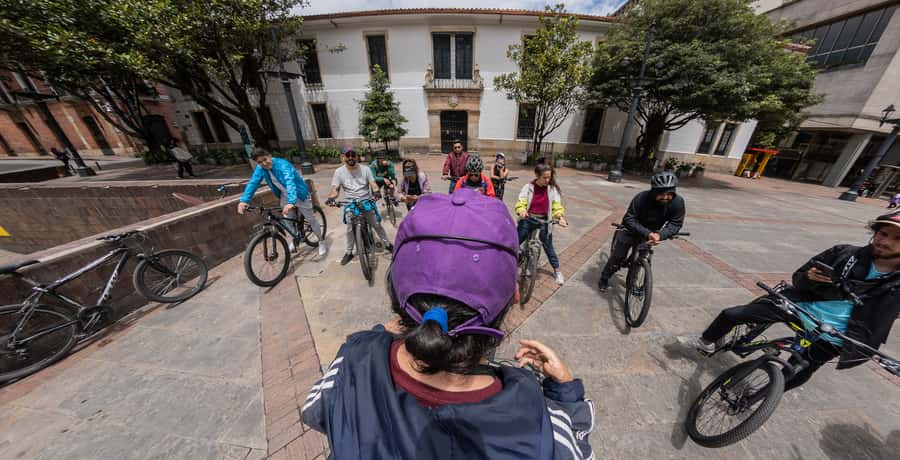
The tour begins in La Candelaria, Bogotá’s historic center, at Carrera 3 number 12-52. Look for the large red wall and a guide wearing a purple hoodie, cap, or carrying a purple umbrella. That clear visual marker matters in a busy part of town, especially if you arrive by taxi or on foot.
La Candelaria is a sensible starting point because it places you near Bogotá’s best-known mix of old streets, public buildings, student life, and street art. The tour does not treat murals as isolated decorations. Instead, the guide connects what you see on the wall with the surrounding neighborhood, its architecture, and the way the city has developed.
You should expect several stops rather than one long ride with commentary shouted over traffic. The format lets you park the bicycles, look closely at an image, and hear why a particular design, symbol, or technique matters. That is important with political art, where the meaning can be missed if you only pause long enough for a photograph.
The guide’s role is central here. The company describes its guides as active in the urban art world, and Diego has led tours with a strong connection to local communities. If Diego is your guide, expect the discussion to move beyond names and dates toward the people and social questions behind the artwork. Languages offered include English, Spanish, French, German, and Italian, but confirm your preferred language when booking.
A few more trips around Bogotá worth a look
- Bogota: Bicycle City Tour
★ 4.9 · 2,156 reviews - Zipaquirá: Salt Cathedral Group Tour with Pickup
★ 4.8 · 1,606 reviews - Bogotá: Guided La Candelaria Walking Tour
★ 4.8 · 1,229 reviews
Thirteen kilometers through four very different districts
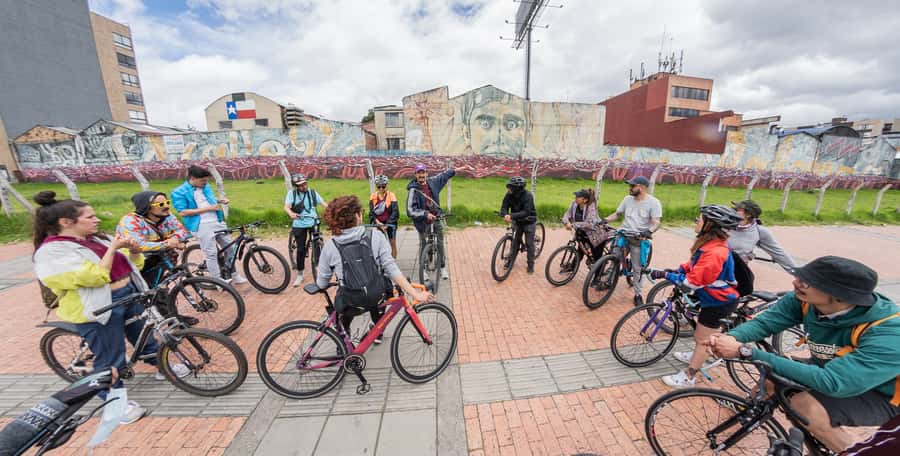
The route covers about 13 kilometers of bike trails and passes through four neighborhoods: Centro, Teusaquillo, Santa Fe, and La Macarena. That distance is manageable for many regular cyclists, but it is not a short stroll with a bicycle. You will be riding between stops, so sports shoes are the right choice.
The value of the route is the contrast. Bogotá does not present one single street-art style or one uniform city center. As you move from one area to another, the buildings, streets, and social setting change. The art gives you a way to notice those shifts, while the guide provides the background that turns a colorful wall into part of a larger civic story.
The city’s bike infrastructure also shapes the experience. A bicycle is quicker than walking between distant murals and more flexible than a vehicle on busy central streets. You can cover ground without spending the tour in traffic, and you get a closer look at ordinary street life along the way.
The tradeoff is physical and practical. You will need to keep pace with the group and pay attention to the route, even though the tour is built around bike trails. Anyone who dislikes cycling in an urban setting may find the pace less relaxing than a walking art tour. Ask about the day’s conditions before setting out if you are uncertain about your comfort on a bike.
Centro: murals as public arguments
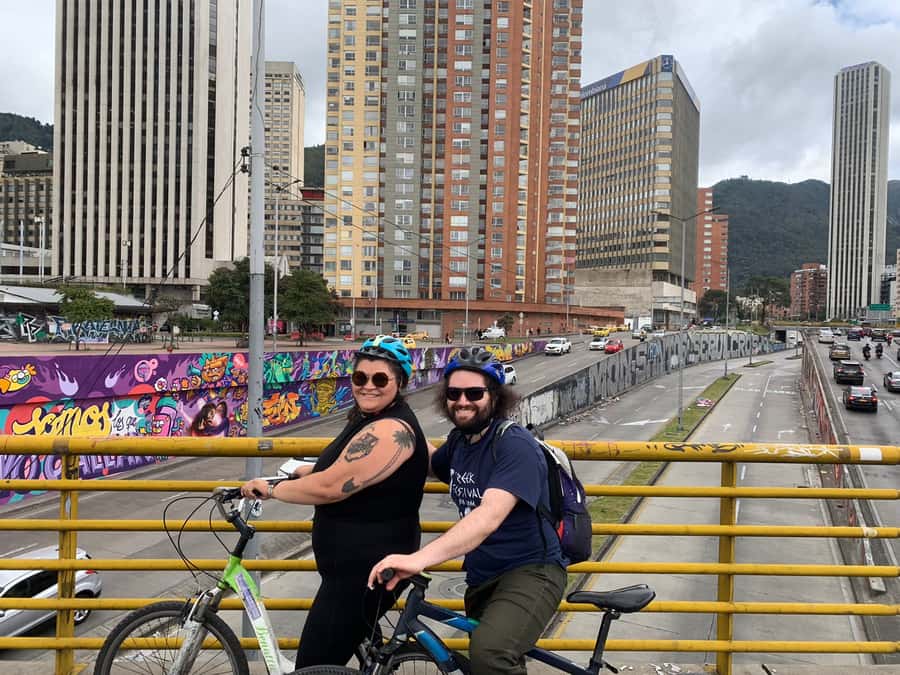
In Centro, expect the tour to frame street art as a form of public conversation. Bogotá’s graffiti movement is not presented only as decoration or a collection of large images. It reflects arguments about power, inequality, identity, memory, and who gets to shape the city’s visual space.
That context is one of the tour’s strongest features. A mural can look striking while still being difficult to understand from a quick glance. The guide explains the work’s history, techniques, and meaning, helping you see choices in color, composition, characters, and symbols that you might otherwise overlook.
The political content may not suit every visitor. Some people want a light art outing and may find discussions of conflict and social struggle heavier than expected. That is part of the point here, though. Bogotá’s street art is tied to public life, and removing that context would leave you with only the surface.
You should also expect the route to include very large walls. The tour makes time for some of the city’s biggest murals, which can be hard to appreciate on foot when they are spread across wide streets or separate districts. The bicycle helps connect these works without turning the outing into a full-day commitment.
Teusaquillo and the art of a changing city
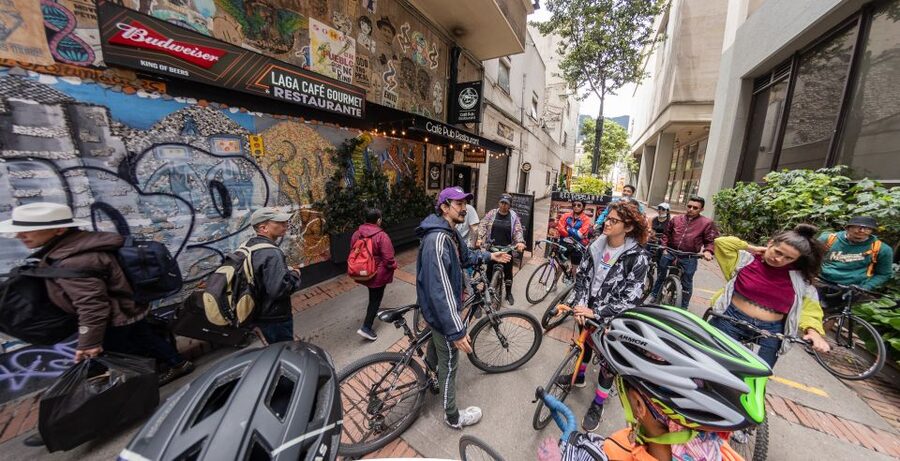
The move into Teusaquillo adds an architectural and urban-planning layer. The tour uses the built environment as part of the lesson, asking you to consider how neighborhoods change and how public art responds to those changes.
You will not simply be shown a wall and told who painted it. The discussion brings in the surrounding buildings, the use of public space, and the relationship between older parts of the city and newer forms of expression. This makes the route useful for visitors who want more than an art checklist.
The focus on women artists is especially worthwhile. Their illustrations give the tour a broader view of Bogotá’s creative scene and prevent the story from becoming a narrow account of famous male muralists. You will see how different artists use characters, color, and visual storytelling to address community and social issues.
Because the tour covers many stops in three hours, individual explanations may vary in length. The benefit is variety. The limitation is that you should not expect a full art-history lecture at every wall. Think of the outing as a guided introduction with selected works, not a specialist course.
Same city, a different sort of day:
- Bogotá: Private City Tour, Monserrate, Emerald and Botero
★ 4.9 · 798 reviews - Bogotá´s Barrios: El Paraíso Favela Tour with Cable Car
★ 4.8 · 731 reviews - Bogota: Guatavita and Salt Cathedral Daily Group Tour
★ 4.7 · 615 reviews - Bogotá City Tour with Monserrate, Gold and Botero Museums
★ 4.9 · 584 reviews
Santa Fe and La Macarena: art, memory, and movement
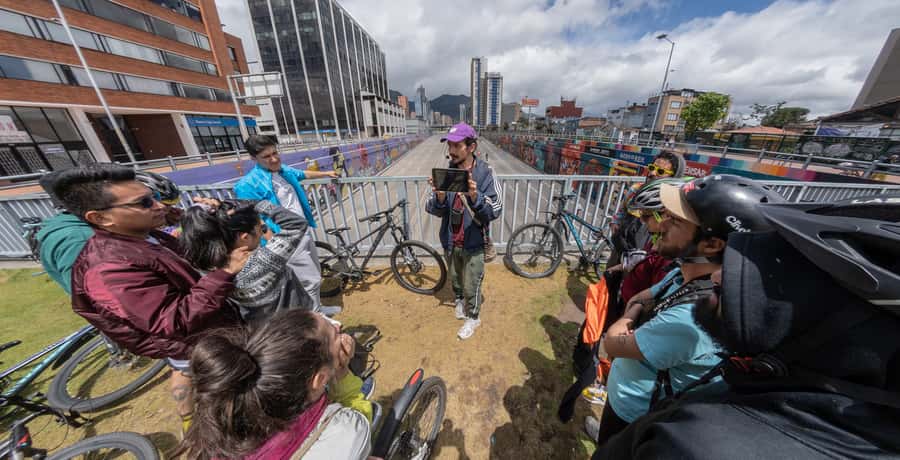
Santa Fe and La Macarena bring more changes in tone and setting as the route continues. The guide uses these neighborhoods to show how street art interacts with the city’s cultural life and its social divisions. You will see how murals can make a wall into a statement about belonging, loss, hope, or resistance.
The most meaningful stop is the mural connected with peace and Colombia’s post-conflict period. Its importance comes from the way art can address a national issue in a public, accessible form. Rather than treating peace as an abstract political slogan, the guide places the mural within Colombia’s effort to repair communities and test new forms of social cooperation.
This part of the tour may be especially useful if you know little about Colombia’s recent history. The guide can provide a starting framework without asking you to become an expert before you arrive. You should still expect a thoughtful conversation rather than a complete account of the conflict and peace process. Three hours allows for an introduction, not every detail.
La Macarena also helps show why bicycles work well for this route. You can move between art, streets, and meeting points without repeatedly arranging transport. The ride itself becomes part of the city lesson, allowing you to notice how central neighborhoods connect.
The coffee-factory stop breaks up the ride
The coffee-factory stop gives the outing a change of pace. After several art discussions and stretches of cycling, a pause connected to Colombian coffee adds a practical local detail to the day.
The stop is not described as a full coffee tasting or a long production tour, so keep your expectations measured. Its value is that it broadens the experience beyond murals. You get a glimpse of another part of Colombia’s cultural and commercial identity while giving your legs a rest.
This also helps the three-hour schedule feel more balanced. A route with multiple art stops could otherwise become repetitive, especially if you are not used to studying murals closely. The coffee stop breaks the rhythm and gives you a chance to reset before continuing.
Sunday Ciclovía or a regular bike-lane departure
On Sundays, the tour may use Bogotá’s Ciclovía, a major city event that opens extra routes for cyclists and adds cultural activity to the morning. This can make the ride feel more relaxed because the city gives bicycles a larger role.
Ciclovía is a strong choice if your schedule allows it. You get to see a different side of Bogotá, one shaped around cycling rather than cars. The atmosphere may also make the ride easier for visitors who are nervous about urban biking, although the route still requires attention and steady movement.
On other days, the tour uses city bike lanes. The basic advantage remains the same: you can reach murals in several districts without relying on a bus or taxi. Check the starting times when booking, since the tour runs for three hours and availability can change by day.
The weather is a real consideration. The tour operates rain or shine, and a rain poncho is offered, but waterproof protection does not make wet cycling comfortable for everyone. Wear shoes suited to pedaling and choose clothing that can handle a sudden shower. Do not bring a backpack or valuables, since those are listed as items not allowed on the tour.
What the $62 price buys you
At $62 per person, this is not the cheapest way to see Bogotá’s street art. The price makes more sense if you value interpretation, bicycle transport, and access to murals spread over a 13-kilometer route.
A self-guided walk would cost less, but you would need to find the walls, understand their references, and work out how to move between four neighborhoods. You would also miss the guide’s explanations of technique, history, and social meaning. A taxi-based mural hunt could become more expensive and less enjoyable, especially when several stops are involved.
The price is easier to justify for a private or small-group departure. You get a more focused setting for questions and a better chance to hear the guide clearly at each stop. Larger groups may offer less personal attention, so ask about the group size before paying if that matters to you.
The value is weaker for someone who only wants quick photographs. Much of the tour’s purpose lies in the stories behind the walls, particularly the sections on women artists, political expression, and peace after conflict. If those subjects interest you, the fee buys more than transportation.
Free cancellation up to 24 hours before the start and the option to reserve now and pay later add useful flexibility. These policies are practical if your Bogotá plans are still shifting, but check the exact conditions at the time of booking.
Who should choose this ride
I would recommend this tour to visitors who want to connect Bogotá’s art with its public life. It suits curious cyclists, first-time visitors seeking an introduction to several central districts, and anyone interested in Colombia’s social change.
It is also a good fit for people who prefer an active morning to a standard bus tour. You will get exercise, see more than one neighborhood, and avoid spending the whole time inside a vehicle.
Families with older children may enjoy the color and movement, provided everyone can manage the distance and city cycling. Art students, photographers, and urban-design enthusiasts should find plenty to discuss, though the tour is still accessible to beginners.
I would hesitate to recommend it to anyone who dislikes cycling, wants a weather-proof plan, or prefers a quiet indoor museum. The route is deliberately active, and the subject matter can be serious. The rain-or-shine policy is worth taking seriously.
Should you book the Urban Art Bike Tour?
Book it if you want Bogotá explained through its walls, not simply photographed. The combination of four neighborhoods, a 13-kilometer bike route, women artists, a peace mural, a coffee-factory stop, and a guide connected to the local art scene gives the outing a clear purpose.
Before booking, make two checks. Confirm the guide language and ask whether Diego is leading if his community-focused approach appeals to you. Then decide honestly if you are ready for three hours of urban cycling in changing weather.
For the right person, $62 is fair value because the guide supplies the context that turns street art into a lesson about Colombia. If you only want a short ride and a few colorful pictures, choose a shorter walking option instead.
FAQ
How long does the Urban Art Bike Tour last?
The tour lasts three hours.
How far do you ride?
The route covers about 13 kilometers of bike trails.
Which neighborhoods does the tour visit?
The tour passes through Centro, Teusaquillo, Santa Fe, and La Macarena, beginning in La Candelaria.
Where is the meeting point?
Meet in front of the large red wall at Carrera 3 number 12-52 in La Candelaria. Look for a guide with a purple hoodie, cap, or umbrella.
Which languages are available?
The tour is offered in English, Spanish, French, German, and Italian.
Does the tour operate on Sundays?
The tour can use Bogotá’s Ciclovía on Sundays, when the city opens additional bike routes and offers cultural activities.
What should I bring?
Bring sports shoes. Backpacks and valuables are not allowed.
What happens if it rains?
The tour operates rain or shine, and a rain poncho is offered.
Just added in Bogotá
- Candelaria Unveiled: Cool-tural Heritage Walking Tour★ 4.4 · 6 reviews
- Bogota: Zipaquira, Salt Cathedral & Lake Guatavitá Tour★ 4.9 · 32 reviews
- BOGOTA: Tour of Jaime Duque Park, Zoo, and Aerospace Museum★ 4.6 · 15 reviews
- BOGOTA: Visit to the Botanical Garden and Ugly Betty’s House★ 4.9 · 15 reviews
- Bogotá: Villa de Leyva Full-Day Tour with Meals★ 4.2 · 10 reviews
- Bogota: Tour to Salitre Mágico, An Extreme Fun Trip★ 4.3 · 7 reviews
- BOGOTA: Tour of Villa de Leyva, Ráquira, Pozos Azules, and Puente de Boyacá★ 5.0 · 8 reviews
- Bogotá: Private Candelaria Walking Tour and Gold Museum★ 5.0 · 17 reviews
Bogotá Tours, compared.
Private City Tour, Monserrate, Emerald and Botero
Read our review →
Bogotá´s Barrios: El Paraíso Favela Tour with Cable Car
Read our review →
Bogotá City Tour with Monserrate, Gold and Botero Museums
Read our review →
Browse the lists this tour appears in