
Reviewed · COMUNA 13 & GRAFFITI TOURS
Graffiti Tour: a fascinating walk through a street art City
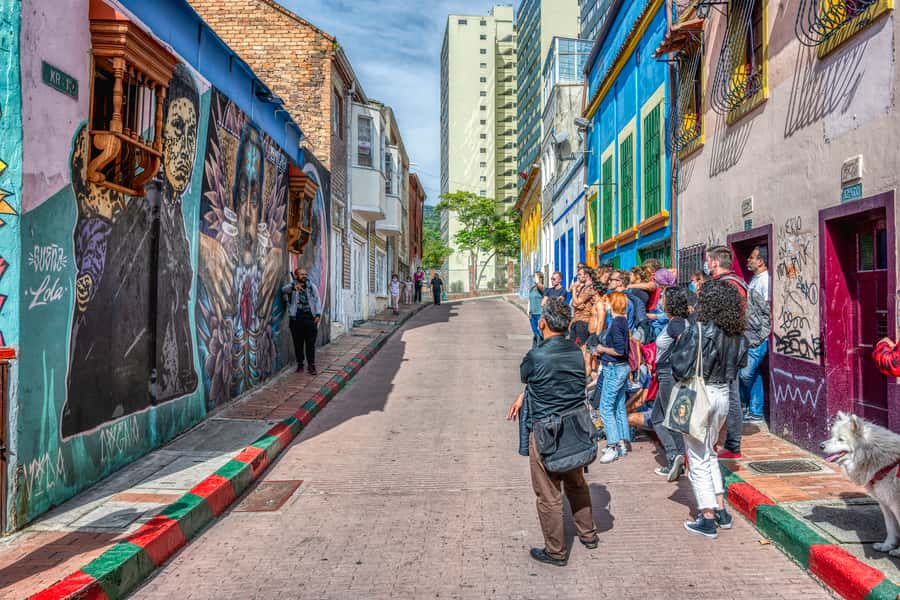
Bogotá’s graffiti is more than colorful paint on old walls. It is a public record of protest, memory, and hope, including the country’s tallest illegal graffiti. I like that this walk connects the artwork to Colombia’s peace process and present-day social debates. I also like that the company reinvests in new murals with local artists and community leaders. The one drawback is that the tour’s strongest appeal depends on your interest in politics and recent Colombian history, not just taking street-art photos.
You’ll meet beside the Gold Museum and look for a guide in a purple hoodie, cap, or umbrella. The price is $15 per person, and the 150-minute format gives you time to examine several works rather than rush from wall to wall. Shared tours include the guide’s suggested tip in the amount you pay, so there is no extra payment at the end.
Key points to know before you book
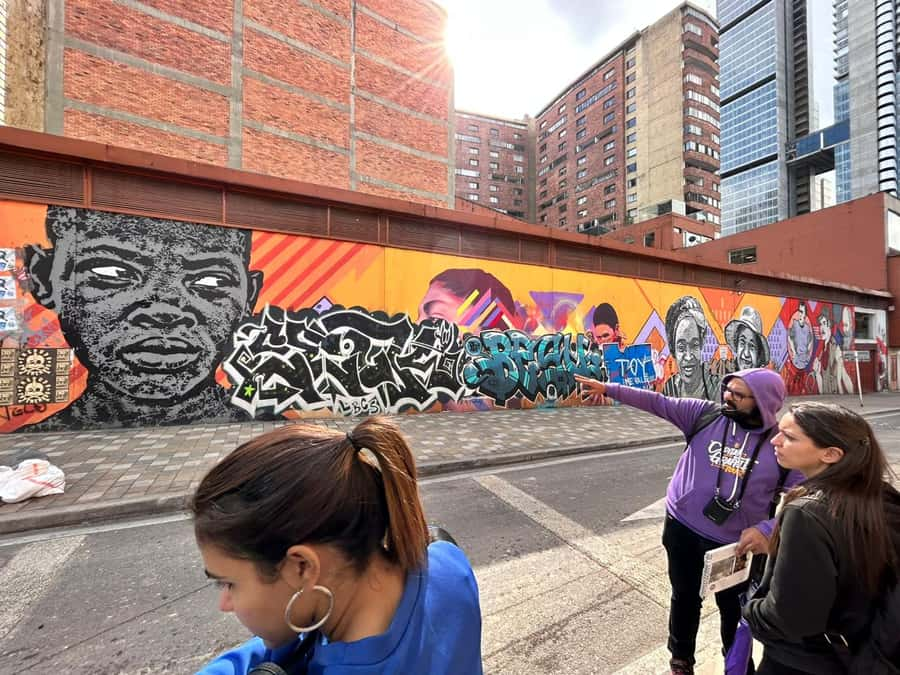
- The tallest illegal graffiti in Colombia is one of the tour’s headline sights.
- Political posters and murals address current social issues directly.
- The peace process helps explain why certain images and messages matter.
- Local artists and community leaders help shape the company’s social-impact work.
- Five guide languages are available: English, Spanish, Italian, French, and German.
- Shared, private, and small-group formats let you choose between value and a more personal outing.
Why Bogotá’s walls tell a bigger story
The best way to approach Bogotá’s street art is to treat it as a conversation. A mural may use color and scale to catch your eye, but the guide’s job is to explain the argument behind it. You’ll hear about artists, techniques, political concerns, cultural references, and the city’s changing identity.
That context matters because graffiti can be easy to admire and hard to understand. A large figure or sharp slogan may refer to events, tensions, or hopes that are not obvious to someone seeing it for the first time. An artist-led guide can point out how an image was made, what inspired it, and why it appeared in that particular part of the city.
The tour also looks at the connection between art and social change. The company presents its walks as educational and cultural experiences, not simple sightseeing. Its work with local artists and community leaders includes financing and managing new murals, so your booking supports an ongoing local project rather than only a single afternoon of viewing.
I appreciate that distinction. You are not just being shown a collection of attractive walls. You are being asked to consider who gets heard in public space, how communities respond to difficult events, and how art can shape the way a city understands itself.
More Comuna 13 and graffiti walks in Bogotá
- Bogotá: La Candelaria Graffiti & Urban Art Guided Tour
★ 4.7 · 250 reviews - Fun Graffiti Workshop: The Art of Aerosol and Color
★ 5.0 · 73 reviews - Graffiti Tour in La Candelaria Bogotá with Transportation
★ 5.0 · 68 reviews
Starting beside the Gold Museum
The meeting point is next to the Gold Museum at Carrera 6 #15-88. This is a useful place to begin because it is a clear central landmark, but you still need to watch for the guide’s identifying clothing. Look for a purple hoodie, cap, or umbrella.
The tour does not provide transport between sites, so expect a walking experience through city streets. The 150-minute duration is long enough for a substantial route, though you should plan for a steady outing rather than a brief introduction. Comfortable walking shoes make sense, and valuables are not allowed.
At the start, your guide should help set the tone by explaining how Bogotá became known for its open-air art and why graffiti has such a strong public role here. Since the guides are artists themselves, the emphasis is not only on what a work depicts. You’ll also learn about process, technique, inspiration, and the choices that make one piece different from another.
The guide may speak English, Spanish, Italian, French, or German. That range is useful if you are traveling with people who prefer different languages, though you should select the language you need when checking available times.
Meeting the city’s illegal giant
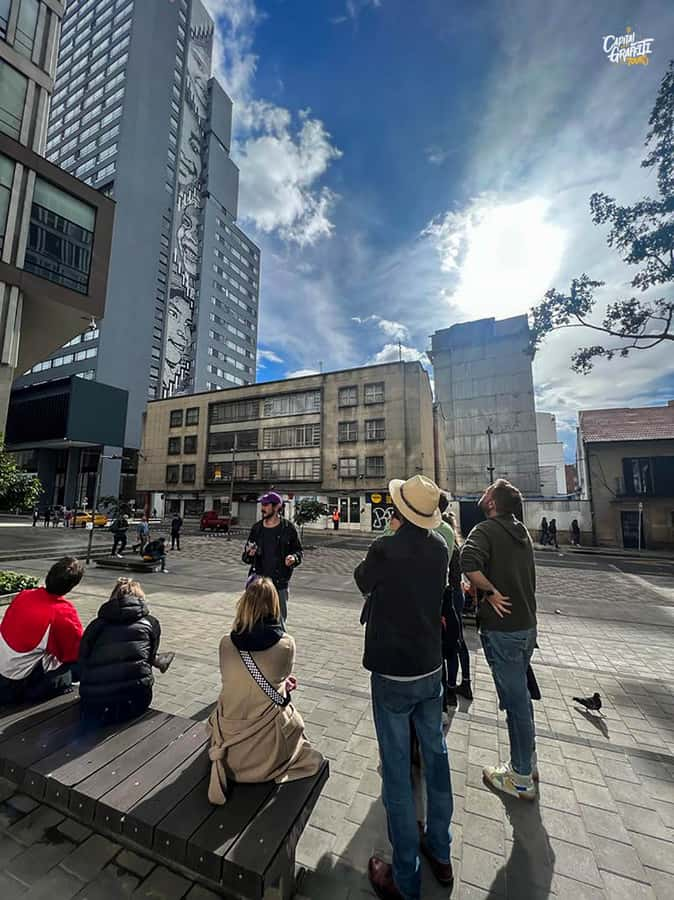
One of the major reasons to choose this walk is the chance to see the tallest illegal graffiti in the country. That phrase alone points to an important tension in Bogotá’s street art. Graffiti can be celebrated as culture, yet it can also be created without official permission, placing artists and communities in a difficult position.
The work’s scale gives the guide a natural opening to explain the difference between an image that simply fills a wall and one that changes how people read a whole section of the city. You’ll be able to consider the technical challenge of making something so large, as well as the public reaction to it.
Do not expect the tallest piece to be the only highlight. Large murals are memorable, but a smaller poster or tightly placed stencil can carry an equally direct message. The value of the stop comes from seeing how size, location, and subject work together.
If you mainly want a quick collection of impressive photographs, this part will likely satisfy you. If you want to understand why an unauthorized work receives attention, the discussion around it is even more useful.
Reading political posters and current social issues
The route includes an area with political posters addressing current social issues. This is where the experience moves furthest from a conventional art walk. Posters can be temporary, blunt, and closely tied to the concerns of the moment, so the guide’s explanation helps place them within Colombia’s wider public debate.
You’ll encounter art that asks you to think about power, public memory, and whose point of view is visible on a city wall. The material may not always be comfortable. That is part of the point. Political graffiti is not designed only to decorate a street. It is designed to interrupt your routine and make an argument.
I like this part because it gives the tour a clear purpose. You are not being told that every image has one simple meaning. Instead, you get a way to read public art as a response to events and social pressure.
The limitation is just as clear. If you prefer a light, purely visual outing, the political content may feel demanding. This is a better choice for someone willing to spend time with difficult subjects and ask why the work was made.
A few more trips around Bogotá worth a look
- Bogotá Street Art and Graffiti Tour 3 Hrs
★ 5.0 · 5 reviews - Medellín: Private Comuna 13 Street Art Tour
★ 4.8 · 88 reviews - 2-Hours Street Art Walking Tour in Medellin Comuna 13
★ 5.0 · 54 reviews - History and Street Art Tour in Comuna 13
★ 5.0 · 35 reviews
Connecting graffiti with Colombia’s peace process
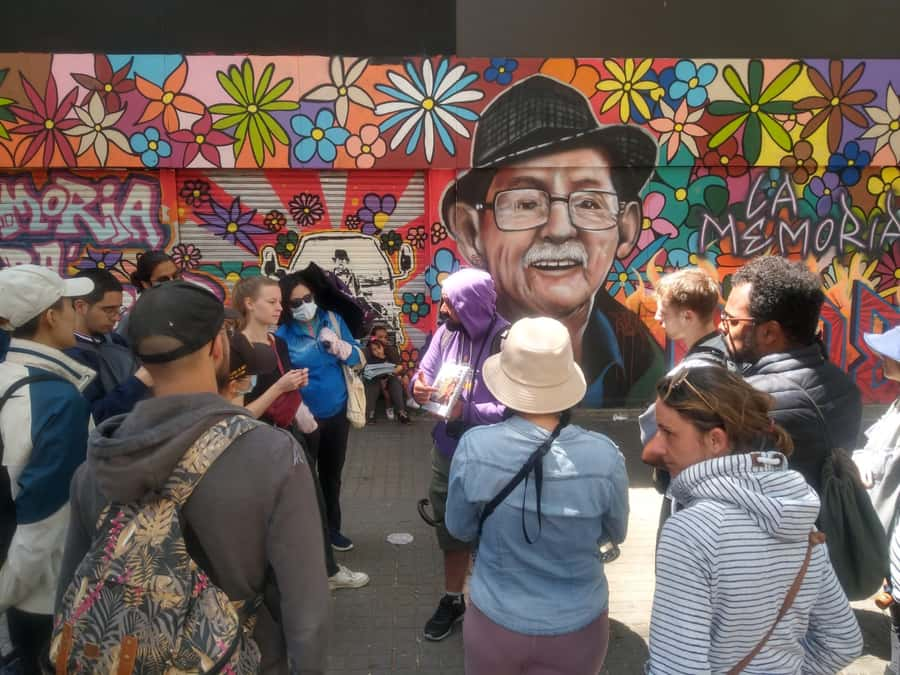
The tour also provides context about Bogotá’s past, its present peace process, and hopes for the future. The exact works you see will carry the visual evidence, but the broader subject gives the route a clear thread.
Art can help express feelings that formal political language misses. A mural may mourn, accuse, remember, or imagine a different future. A poster can make a public claim in a few words. The guide’s role is to connect those expressions to the city and country around them without reducing the work to a simple history lesson.
That connection is valuable for you as a visitor because Colombia’s recent story is complex. You may recognize images of conflict, resistance, reconciliation, or community, but you may not know the local references. The tour offers the background needed to see those references as part of an ongoing conversation.
The peace-process material also keeps the experience current. This is not a walk through a frozen collection of famous paintings. The art reflects a society still working through hard questions and imagining what comes next.
Seeing community resilience after false positives
One of the tour’s stated themes is the resilience of the community in the face of false positives. The phrase refers to a painful subject in Colombia, and the tour treats community response as an important part of the story.
The provided information does not set out a detailed account of each work connected to this theme, so you should expect the guide to supply the specific context during the walk. What is clear is that the experience does not present communities only as victims. It focuses on resilience, expression, and the ability to use public art to keep memory and social concerns visible.
This is another reason to choose the tour for its interpretation, not just its route. Without explanation, you might pass a powerful image and miss what it means to the people who live around it. With context, the wall becomes part of a larger community statement.
The subject may be emotionally serious. That is worth knowing before you book. The tour is intended to educate and inspire, but it does not promise an easy or carefree subject matter from beginning to end.
How the guides shape the experience
The guides are artists and promoters, not only people assigned to lead a route. Their background should affect the way they describe technique and artistic intent. You can expect attention to the artists behind the work, their sources of inspiration, and the political, cultural, historical, and geographical setting.
No individual guide names are provided, so I would not book this expecting a particular person. Instead, focus on the language and group format that suit you. English, Spanish, Italian, French, and German are available, and you can choose a private or small-group option if offered for your date.
A shared walk is the most economical version. At $15 per person, the amount is described as the suggested tip for the guide’s work, less commission. You do not have to add another payment at the end, even if other people in the group choose to contribute.
That arrangement makes the price good value if you want two and a half hours of guided interpretation. It also supports the company’s stated work with artists and community leaders. A private or small-group format may cost more, but the supplied information does not give those prices, so check before making a decision.
What the 150-minute length means
Two and a half hours is a useful middle ground. A shorter walk could show you a few famous pieces without giving enough time for political and historical background. This format allows several locations and room for discussion.
The route is on foot, and the tour is described as wheelchair accessible. You should still confirm the route details when booking if you have specific mobility needs, since the supplied information does not describe pavement, slopes, or restroom access.
The length also means you should not treat the outing as a quick add-on between tightly scheduled museum visits. Give yourself enough time to reach the Gold Museum meeting point and be ready for a sustained walk.
Because the route focuses on public art, the experience is likely to change as Bogotá’s walls change. Some works may be painted over, altered, or replaced. That is not a flaw in the concept. It is part of the nature of street art, but it means the exact visual selection may differ from what you imagine.
Who will get the most from this walk
I would recommend this tour to you if you want to connect street art with politics, local culture, and community action. It suits first-time visitors who need help reading Bogotá’s public art, as well as art-minded visitors who want to understand how techniques and messages work together.
It is also a good choice if you value spending money with an organization that supports new murals and works with local artists. The social-impact aim is built into the experience, rather than added as a vague promise.
Families and mixed groups can consider it, but the political topics may require more attention than a standard sightseeing walk. Children who enjoy drawing or public art may like the visual side, while older participants may get more from the historical and social discussion.
I would be less likely to recommend it to you if your main goal is a relaxed photo walk with little explanation. The political posters, peace-process material, and discussion of false positives make this a serious cultural outing.
Booking details that matter
You can cancel up to 24 hours in advance for a full refund. The reserve-now, pay-later option keeps your plans flexible, with no payment required today.
Shared, private, and small-group options are available. The basic price is $15 per person, but check the final amount for any private or small-group choice before booking.
The meeting point is next to the Gold Museum, Carrera 6 #15-88. Find the guide by looking for a purple hoodie, cap, or umbrella. Valuables are not allowed, so pack lightly and avoid bringing items you do not need.
Should you book Capital Graffiti Tours?
Book it if you want Bogotá’s street art explained as living public culture, not just decoration. The tallest illegal graffiti in Colombia, political posters, peace-process themes, and community resilience give the 150-minute walk a strong purpose.
At $15, the shared option offers solid value for an artist-led route with several locations and five possible languages. Choose it with realistic expectations: this is a serious, educational walk, and the subject matter can be difficult. If that sounds worthwhile, meet the purple-clad guide beside the Gold Museum and let the walls do more than provide a backdrop for photographs.
FAQ
Where does the graffiti tour meet?
The meeting point is next to the Gold Museum at Carrera 6 #15-88 in Bogotá. Look for a guide wearing a purple hoodie or cap, or carrying a purple umbrella.
How long does the tour last?
The tour lasts 150 minutes.
How much does the tour cost?
The shared tour costs $15 per person.
Is the shared-tour amount an additional tip?
No. For the shared option, the amount paid per person covers the suggested tip for the guides and their work, minus commission. You do not have to pay anything extra at the end.
Which languages are available?
Live guides are available in English, Spanish, Italian, French, and German.
Is the tour wheelchair accessible?
Yes, the activity is described as wheelchair accessible.
Can I book a private tour or small-group tour?
Yes. Private and small-group options are available.
Can I cancel for a refund?
Yes. You can cancel up to 24 hours in advance for a full refund.
Do I have to pay when I reserve?
No. The reserve-now, pay-later option lets you keep your plans flexible and pay nothing today.
Just added in Bogotá
- Zipaquira: 5 hrs Salt Cathedral Tour★ 4.4 · 9 reviews
- Zipaquirá: Private tour to the Salt Cathedral, Colombia’s first wonder★ 4.9 · 33 reviews
- Wonders of Salt: Colombia’s Underground Cathedral★ 5.0 · 18 reviews
- Zipaquirá Salt Cathedral & Andrés Carne de Res (Chía)★ 4.6 · 30 reviews
- Private Zipaquira Salt Cathedral and Guatavita Lagoon Tour from Bogota★ 4.5 · 44 reviews
- MINA CATEDRAL DE SAL ZIPAQUIRA Tour Privado★ 4.5 · 38 reviews
- Hiking to the largest paramo on earth : Sumapaz★ 5.0 · 49 reviews
- Theatron Party-Tour, 20 Clubs, Map, cocktail, bottle, After-party★ 5.0 · 27 reviews
Comuna 13 & Graffiti Tours, compared.
Comuna 13 Graffiti Tour, Cable Car & Street Food
Read our review →
Private City Tour with Metrocable and Comuna 13
Read our review →
Comuna 13 Tour with Snacks And Your Own Graffiti
Read our review →
Comuna 13 and Graffiti Guided Tour with a Local
Read our review →
Browse the lists this tour appears in